
East Amherst Solar Project
Project Overview
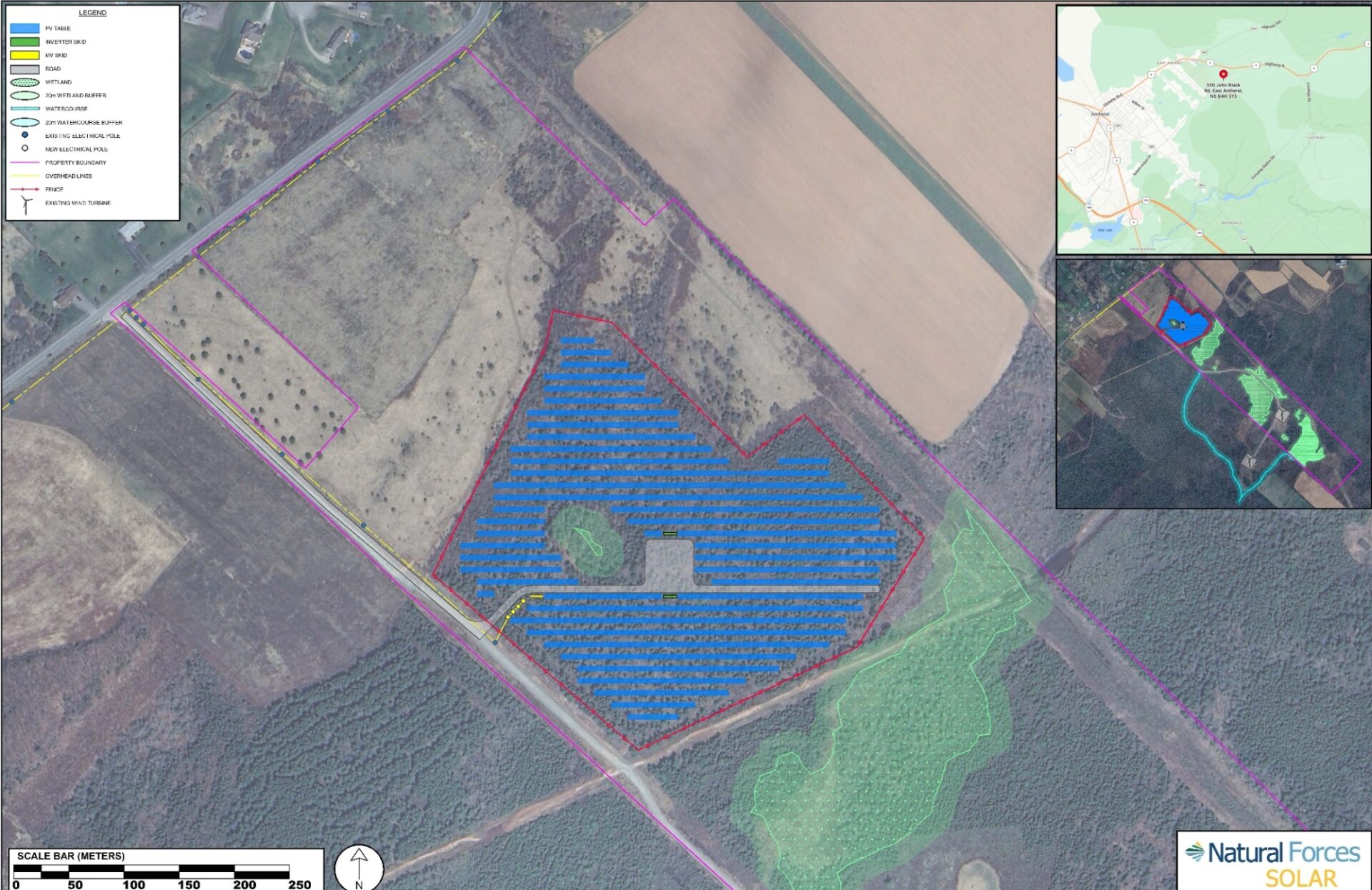
The proposed East Amherst Solar Project is being developed by Natural Forces Solar. The Project is located on the ancestral and unceded territory of the Mi’kmaq people, we acknowledge that working on these lands is a privilege that comes with a great deal of responsibility. The East Amherst Solar Project will have an installed capacity of approximately 5.3 MWAC, comprising approximately 12,700 solar photovoltaic (PV) modules. It is proposed to be located at 530 John Black Road, in the community of East Amherst. The site was chosen as it is the site of an existing wind energy project and is therefore well-understood to pose minimal environmental impacts.
Project Proponent
Natural Forces Solar is a privately owned renewable energy engineering, procurement, construction, and maintenance company based in Nova Scotia, Canada. Founded in 2019, the company specializes in commercial and utility-scale solar PV, energy storage, and microgrid projects, delivering design-build services to dozens of government institutions, community organizations, private corporations, and First Nations communities. Over the past six years, we have installed more than 90 solar PV systems, with another 10 projects under construction or planned for 2026. Natural Forces Solar’s unique value lies in our management team’s combined six decades of experience owning and operating renewable energy projects, enabling a holistic approach that carefully manages community engagement, permitting, financing, construction, and long-term maintenance risks.
Project Benefits
- Generate about 8,500,000 kWh per year of clean renewable energy, powering the equivalent of 850 homes.
- Create local employment and contracting opportunities during the development, construction, operation, and decommissioning phases of the project.
- Produce emission-free electricity that will increase energy security, displace generation from fossil fuels, and reduce greenhouse gas emissions.
- Assist the province in meeting Nova Scotia’s renewable energy target of 80% net zero electricity by 2030.
Project Timeline
1 Development (Current Stage)
- Assess the solar resource
- Survey for environmentally sensitive features
- Consult with rightsholders, regulators and community stakeholders
- Apply for remaining permits
- Optimize the project design to capture the sun efficiently and minimize impact on sensitive features
- Secure necessary financing
2 Construction
- Prepare lands for construction
- Build and/or upgrade access roads
- Install foundations and assemble solar panel racks
- Install the solar panels & additional electrical equipment
- Connect system to the grid
- Commission & energize the system
3 Operation
- Monitor remotely for real-time alerts when additional maintenance is needed
- Conduct periodic in-person site visits
- Operate for 20+ years
4 Decommission or Retrofit
- Assess the solar panels, electrical circuits and equipment after 20 years
- Decommission project components and reclaim the site to its former state OR
- Receive approvals and permits to continue producing clean energy
Public Consultation
Natural Forces is committed to engaging with the public, stakeholders, and special interest groups throughout the lifetime of the project. Below is information about the major public and stakeholder engagement activities that have taken place to date, including discussions and summaries of the information that has been shared at our information session.
Information Session: What we heard?
- Summary: Engagement Session I – 10 March 2026
Environmental Studies
Natural Forces Solar recognize that environmentally and socially responsible development is the cornerstone of a successful project.
Natural Forces Solar engaged Fundy Engineering & Consulting to complete a watercourse and wetland delineation (WWD) review of the project site. Based on the assessment, two portions of unnamed watercourses both believed to be non-fish bearing, have been discovered.
In line with the best practice as described in the Federal and Provincial Order of Preference, we intend to avoid all wetlands and watercourses. If that is not possible, then the impacts will be compensated: in Nova Scotia, there must be compensation at a ratio of 2:1 through the restoration, creation, and/or enhancement of wetland habitat.
Natural Forces Solar also engaged the Special Places (SPP) division of Communities, Culture, Tourism & Heritage to conduct desktop studies for Archaeology, Botany, Geology and Zoololgy.
SPP noted that nearby ponds, lakes and streams increase the archaeological potential and cultural sensitivity. However, no registered archaeology sites exist on the site
SPP found that twelve species of rare plants in the Nova Scotia Museum database have been found within 10 km of the site. However, no plant species at risk appear within the communities and places immediately adjacent to the site. The Fundy Engineering survey also included observations of flora. A total of approximately 57 species were observed, none of which are considered rare. Fundy found that the Atlantic Canada Conservation Data Centre (ACCDC) holds a record of the vulnerable halberd-leaved tearthumb at the site, however no individuals were observed during the delineation work. Natural Forces Solar will conduct a Species at Risk (SAR) survey, including a rare plants survey, to confirm the protection of vulnerable plants.
The SPP report noted that, while endangered monarch butterflies have been observed in the region, the Nova Scotia Museum has no records of animal species at the site or adjacent area. Fundy noted ACCDC records of vulnerable migratory birds and rare arthropods in the vicinity. Natural Forces Solar’s SAR survey will look for fauna such as these to confirm that impacts can be mitigated or avoided.
Finally, SPP noted that no bedrock will be exposed, so encountering paleontology resources is unlikely.
FREQUENTLY ASKED QUESTIONS (FAQ)
Are there any environmental sensitivities near the proposed site?
The wetlands and watercourses on the sites have not been deemed to be wetlands of special significance (WSS). The solar system design incorporates buffers and stormwater management best practices to minimize impacts.
Why does Nova Scotia Power have to be involved with the sale and distribution of power?
Electricity is regulated by provincial law. This project will be applying to the Nova Scotia Community Solar program.
Do solar farms require maintenance? Will chemicals be used to keep site vegetation under control?
Solar farms do require maintenance:
- A farm of this size requires bi-annual visits from a maintenance provider to conduct quality control testing, ensuring the system and all its components are working correctly.
- Vegetation will be actively managed, either by machine (mowers & trimmers) or by sheep, to keep the site & soil in good condition. Chemicals will not be used for vegetation control at the site. Any vegetation control activities will be mechanical or biological (i.e. sheep) in nature.
- The system is monitored remotely 24/7, so any faults can be detected quickly and rectified. As there are no moving parts in a solar farm, they are very low maintenance.
Do the panels attract lightning?
The solar farm will be thoroughly bonded and grounded; these lightning protection systems reduce the risks posed to the farm from a lightning strike. As the solar farm will be lower than the surrounding trees, there will be no increased risk from a lightning strike at the project site.
Will the project produce a lot of noise during operations?
Solar projects do not create a lot of noise; the loudest noise would be the inverter fans which is not very loud at all at less than 80 decibels. The project is not expected to create significant noise levels. We estimate that the sound of the inverters at the nearest house will be between 30 dB and 37 dB, which is comparable to a loudness between a whisper and a quiet library.
How big is each solar panel?
The average size of each solar panel is approximately 2.4 meters by 1.1 meters. This solar system is comprised of over 12,700 solar panels.
How long do solar panels last, and what happens to them after?
The manufacturer of the solar panels to be used for this project provide a 15-year product quality & process guarantee, and 30-year power guarantee; they predict that after 30 years, the modules will still be producing 87.4% of their rated energy capacity. After modules are decommissioned, they are recycled. Each module is approximately 90% recyclable1.
How is this green power when everything must be mined to get the materials?
Solar farms are significantly more environmentally friendly, “green”, than other energy sources, even when considering the environmental impacts of the resource extraction. The lifecycle emissions of a coal power plant, where most of Nova Scotia’s power currently comes from, is 675 gCO2e/kWh to 1689 gCO2/kWh2. The lifecycle emissions of a solar farm, including resource extraction and manufacturing of the module, is 23 gCO2e/kWh to 85 gCO2/kWh3. Solar farms therefore create a 87% to 99% greenhouse gas savings on a lifecycle basis.
Do solar farms require a lot of water to keep them clean or keep dust and dirt under control?
In some climates and under some conditions, solar modules can benefit from being periodically washed to remove dirt. However, based on our local experience, the amount of precipitation Nova Scotia receives year-round has proved more than sufficient to keep modules clean. The site is not anticipated to produce much dust during construction due to the soil composition and presence of vegetation.
Will the solar farm cause erosion?
The solar farm is not expected to affect the local erosion patterns. Vegetation will be grown under all the solar modules to ensure the site’s soil is maintained and is not negatively affected by project construction.
For more information, please contact
Mitchell Van Oosten, Manager of Project Development
community@naturalforces.ca


